

5 Useful Tools for Growth Marketing
- May 18, 2021
- 5 min read
Updated: Aug 9, 2022

We learned what growth marketing is and what its prerequisites are. Now let's become a bit more practical.
In this article, I've gathered 5 growth marketing tools that you can experiment with to make your marketing performance more efficient. These tools will make your work a lot easier and even more enjoyable. Are you ready? Let's go!
1. Copy.ai for advancing your copywriting skills

Free trial: 7-day free access Pricing: $35/month
If you're looking for a tool to help you with copywriting, you should try out copy.ai. It's an automated service that can help you create high-quality content quickly and easily.
It uses artificial intelligence technology, which means that it will not only save you time but also allow you to produce even more content than would be possible otherwise.
All you need to do is visit their webpage, create an account, and chose what kind of copy you're working on. The service has over 70 templates, which will let the tool create a copy that fits what you are looking for. The content you can create includes: digital ad copy, product description, Instagram captions, brand mission, and others. Once you select the template, you can write few details about your company to help tailor the copy to your needs.
It doesn't matter if you are a beginner or an experienced copywriter, because in any case, you will benefit from this copywriting software. While nobody is watching, I like to use it when I write articles for my blog. Copy.ai will help you avoid frustration, stagnant writing, missed deadlines, and uninspired writing. It makes the process of writing fun because it allows you to write like a pro regardless of your level.
2. Semrush for finding solutions for SEO, PPC, content, social media, and competitive research
Pricing: several searches free
Full version: from $119.95/mo
Semrush is a useful marketing tool for improving online visibility and discovering marketing insights. This SaaS platform will benefit you lot in terms of SMM, PPC, SEO, Keyword Research, Competitive Research, Content Marketing, Campaign Management, Marketing Insights, and PR. Also, it provides a huge amount of valuable information about your competitors' traffic, keywords, ad campaigns, and more. Hence, I like to think of Semrush as a public Google Analytics of your competitor :) Check it for yourself. As an example, let's consider a middle-sized SaaS company Sumologic.

From this screenshot, you can see different information about Sumologic website. All you needed to do is put their domain name into the Semrush search. So imagine if Sumologic were your competitors, how extensively you can learn from them: organic and paid traffics, keywords, analytics and more.
3. UsabilityHub for running quick experiments
Free access to basic test Pricing: $79/month
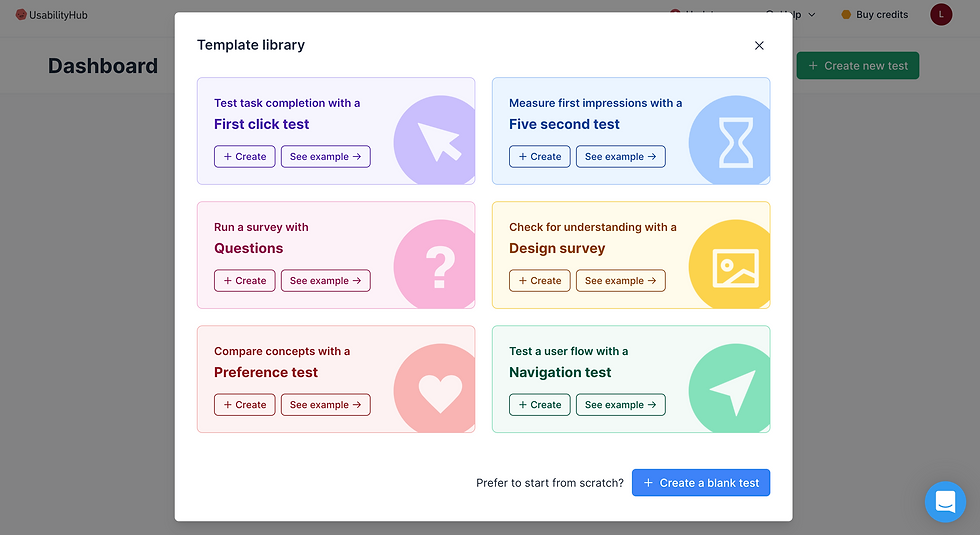
UsabilityHub is a great user testing tool for completing simple design surveys and tests with both your own participant pool or UsabilityHub audience. As you can see from the above picture, there are different types of experiments you can run. Let's look at each one by one:
First click test
This test allows you to measure the usability of your website, app, or prototype by finding out how easy it is for a user to complete a given task. This test aims to evaluate whether it is clear and easy for participants to navigate your website or device.
The cursor position and timing of their click are recorded. Further feedback can be gathered at the end of the test by asking the user to explain why they clicked where they did.
Questions
Asking questions is a simple and standardized way of measuring your design. This option works by displaying questions one at a time without images.
Preference test
In this test, you can ask participants to choose a preference between different designs to understand what matters to them. In this test, a participant is shown several design options and is asked to choose one.
It becomes very handy when you need to compare logos, icons, color palettes, mock-ups, or any other (up to six) designs at the same time.
Five-second test
This test allows you to measure how well your design communicates a message. It runs by showing participants a home page or product mock-ups for 5 seconds, then the screenshot disappears and the participants get asked questions.
For example, you can make a screenshot of your landing page and see whether users can understand within the given time what your business is about and what its value proposition is.
Design survey
Try a design survey to get feedback about your design. Unlike the 5 second test, your image doesn't go anywhere - instead, it's shown simultaneously with your questions. This means that participants can review your work without time pressure.
Navigation test
This test shows how participants navigate through your application or website. At the beginning, the user receives a specific task from the developer; for example, to place the product in a shopping cart or to find the product description. The results give you a picture of user flows, where they click, and how they interact with your platform.
To run the test, you upload a series of screenshots to imitate integration flow and allocate a particular task for users. Then, the users see a picture and click on it to reach the complete the task. If they clicked correctly, they proceed to the next step. If not - the test ends and the users can give feedback on why they chose to click where they did.
Personally, I love this tool because you can get feedback on different projects you are working on fast and easily.
I advise you to run a quick experiment with the use of Copy.ai and UsabilityHub and see if your potential clients understand what your business is about and what is unique about it. This experiment takes less than 5 minutes, so make sure to check it out here.
4. BuzzSumo for finding the content that performs best
Free trial: 30 days
Prising: $99/month
BuzzSumo helps identify the most popular content to target on social media and search engines.
The tool can be used for different activities such as:
Exploring new content ideas
Building your organic content strategy
Carrying out competitor analysis
Minimizing online ad spend
Monitoring mentions and creating media coverage reports
And more.
I like to use BuzzSumo when I feel stuck with content creation. When I am in need of inspiration, I simply enter a domain or keywords on the website to find out what topics are trending.
5. Similar Web for analyzing competitors' web traffic
Pricing: free limited version
Full version: from $249/month
SimilarWeb - is an easy tool, which provides web analytics services and offers its users information about traffic on various websites. All you need to do is enter the domain of a company you would like to spy on. For example, Spotify:


In the report, we can see website traffic overview, traffic by country, traffic source, advertising display, similar sites, and even referrals:

All of this information is very useful when you are conducting competitor analysis. You can learn a lot about their strategy, as well as find the key to their success.
The disadvantage of the service is that it doesn't find all the websites. For instance, if your competitor has low traffic, then there is a high probability that it won't be found in Similar Web's database.
Conclusion
A growth marketer is as good as his toolbox.
That's why you must always be on the lookout for more and better tools.
The tools listed above can help you run experiments or do your current tasks more effectively.


Comments